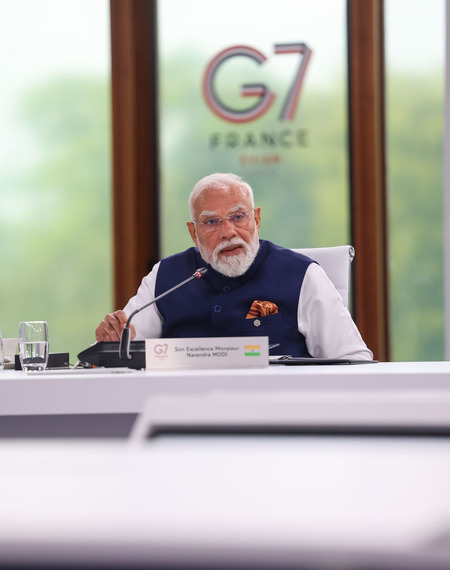
Indian Prime Minister Narendra Modi used his address to G7 leaders on Tuesday to raise concerns over the deaths of Indian seafarers in recent US military action near the Gulf of Oman, speaking in the presence of US President Donald Trump as tensions over Middle East shipping routes continue to grow.
Speaking during the session on “Forging New Partnerships and Rebuilding International Solidarity” in France’s Evian, Modi linked the human cost of the conflict to wider risks facing global trade through the Strait of Hormuz.
“We welcome the progress made in peace efforts in West Asia. This conflict has caused loss of life and property in our friendly countries in the region. Disruptions to maritime trade through the Strait of Hormuz have adversely affected the global economy,” the PM said.
Indian Seafarer Safety In Focus
Modi said the safety of civilian maritime workers must remain a global priority, especially as commercial crews operate through high-risk routes.
“Several Indian civilians have also lost their lives. The safety of seafarers, who connect nations through global maritime trade, is our responsibility. We must ensure that sea routes remain secure and that seafarers can carry out their work without fear,” he added.
While Modi did not directly name the Settebello incident, his comments came days after three Indian nationals died when US forces attacked the Palau-flagged oil tanker Settebello in the Gulf of Oman.
The vessel had 28 crew members, including 24 Indian nationals, two Pakistanis, one Ukrainian, and one Russian. US forces struck the tanker after it allegedly failed to follow instructions and was said to be carrying oil from Iran in violation of a US blockade.
Three Indian-Crewed Vessels Targeted
The Settebello was one of three merchant vessels with Indian crew members targeted in separate US military actions.
On June 8, US forces disabled the Palau-flagged tanker Marivex, which had 24 Indian seafarers on board. All crew members were safely rescued. On June 9, the Settebello was attacked, killing three Indians. On June 11, US forces targeted the Guinea-Bissau-flagged Jalveer, which carried 20 Indian crew members.
The US Central Command said it acted against Marivex, Settebello, and Jalveer because the vessels were attempting to violate the US blockade of Iranian ports. In the Jalveer case, a combat aircraft fired two Hellfire missiles into the engine room after the crew repeatedly failed to comply with directions.
India Lodges Strong Protest
All three vessels were foreign-flagged, two under Palau and one under Guinea-Bissau. None were Indian-owned.
On Thursday, India’s Ministry of External Affairs confirmed the US Navy’s role in the attacks and lodged a strong protest. Spokesperson Randhir Jaiswal said the strikes “must stop.”
The ministry summoned US Charge d’Affaires Jason Meeks and handed him a demarche expressing India’s deepest concern.
“We attach high importance to the welfare and well-being of our seafaring community. When this particular attack on the ship Settebello occurred, we lodged a strong protest with the American side,” Jaiswal said. “We summoned the US Charge d’Affaires and he was conveyed our deepest concern over the ongoing incidents of attacks. We also registered our strong protest.”
Modi’s G7 remarks signal New Delhi’s push to keep civilian crew safety and secure maritime trade high on the international agenda as Middle East tensions continue to threaten key shipping corridors.