

Parvasi Media News
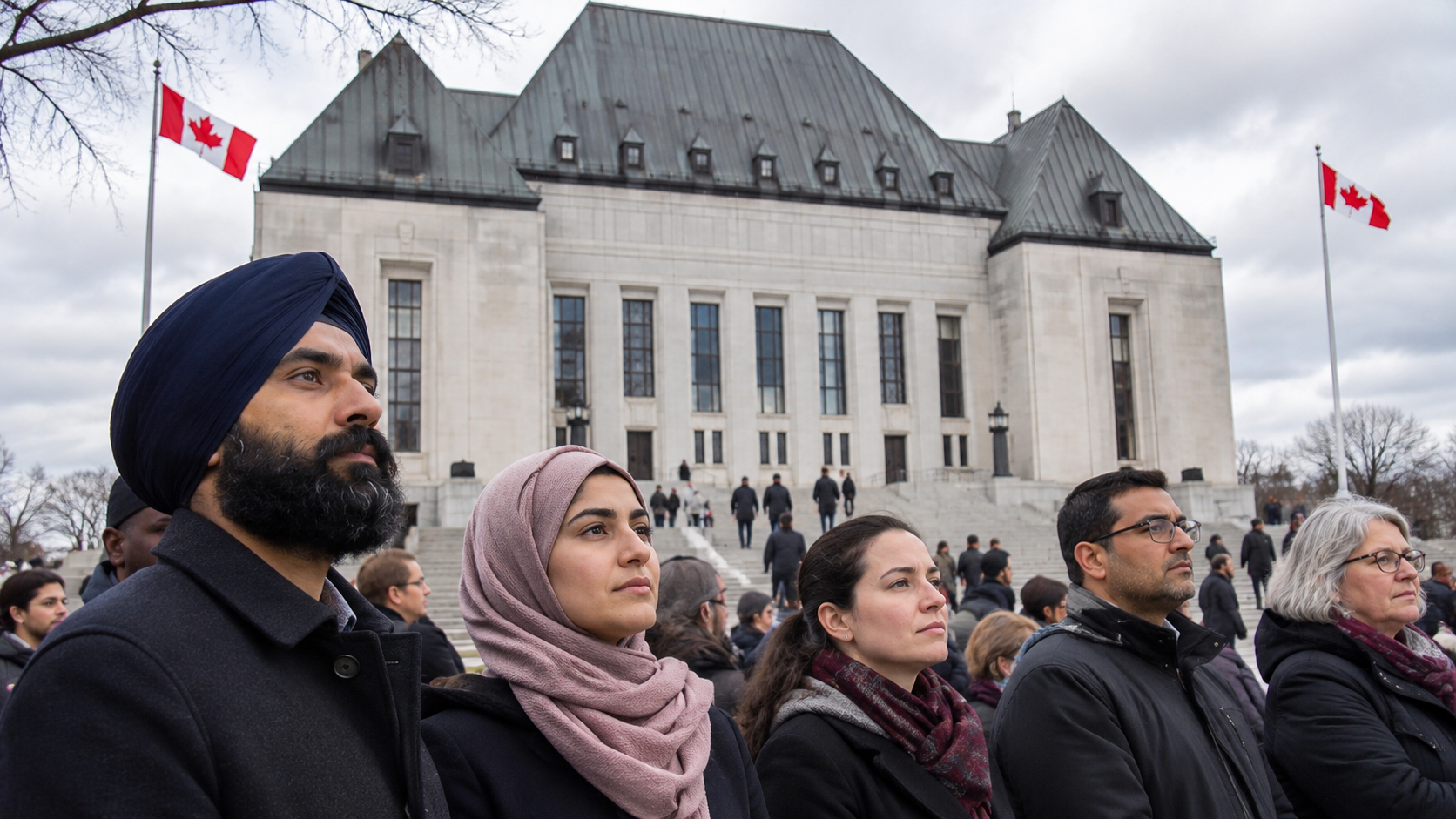
Canada’s Supreme Court is set to deliver a landmark ruling on Quebec’s controversial Bill 21, a secularism law that restricts certain public-sector employees from wearing religious symbols while performing their duties. The decision could have consequences beyond Quebec, affecting religious freedom, constitutional rights and the balance of power between provincial governments and the courts.
Passed in 2019 by the Coalition Avenir Québec government, Bill 21 applies to public-sector workers in positions of authority, including teachers, police officers and judges. It restricts the wearing of visible religious symbols such as Sikh turbans, Muslim hijabs and Christian crosses while carrying out official duties. The law also requires certain people providing or receiving government services to have their faces uncovered.
To protect the legislation from constitutional challenges, Quebec invoked Section 33 of the Canadian Charter of Rights and Freedoms, commonly known as the notwithstanding clause. This provision allows governments to override certain Charter rights for renewable five-year periods. Critics argue that using the clause pre-emptively limits the ability of courts to protect fundamental freedoms.
The legal challenge has raised several major questions, including whether governments can use the notwithstanding clause without justification, whether courts can still declare that a law violates Charter rights, and whether Bill 21 disproportionately affects women who wear religious head coverings. The rights of Quebec’s English-speaking minority and other constitutional issues are also part of the case.
The ruling is being closely watched across Canada because Quebec, Ontario, Saskatchewan and Alberta have all used the notwithstanding clause to protect controversial legislation. Legal experts say the Supreme Court’s decision could shape how the clause is used in the future and influence relations between federal and provincial governments. The court’s judgment is expected to have lasting implications for religious freedom and constitutional law in Canada.

