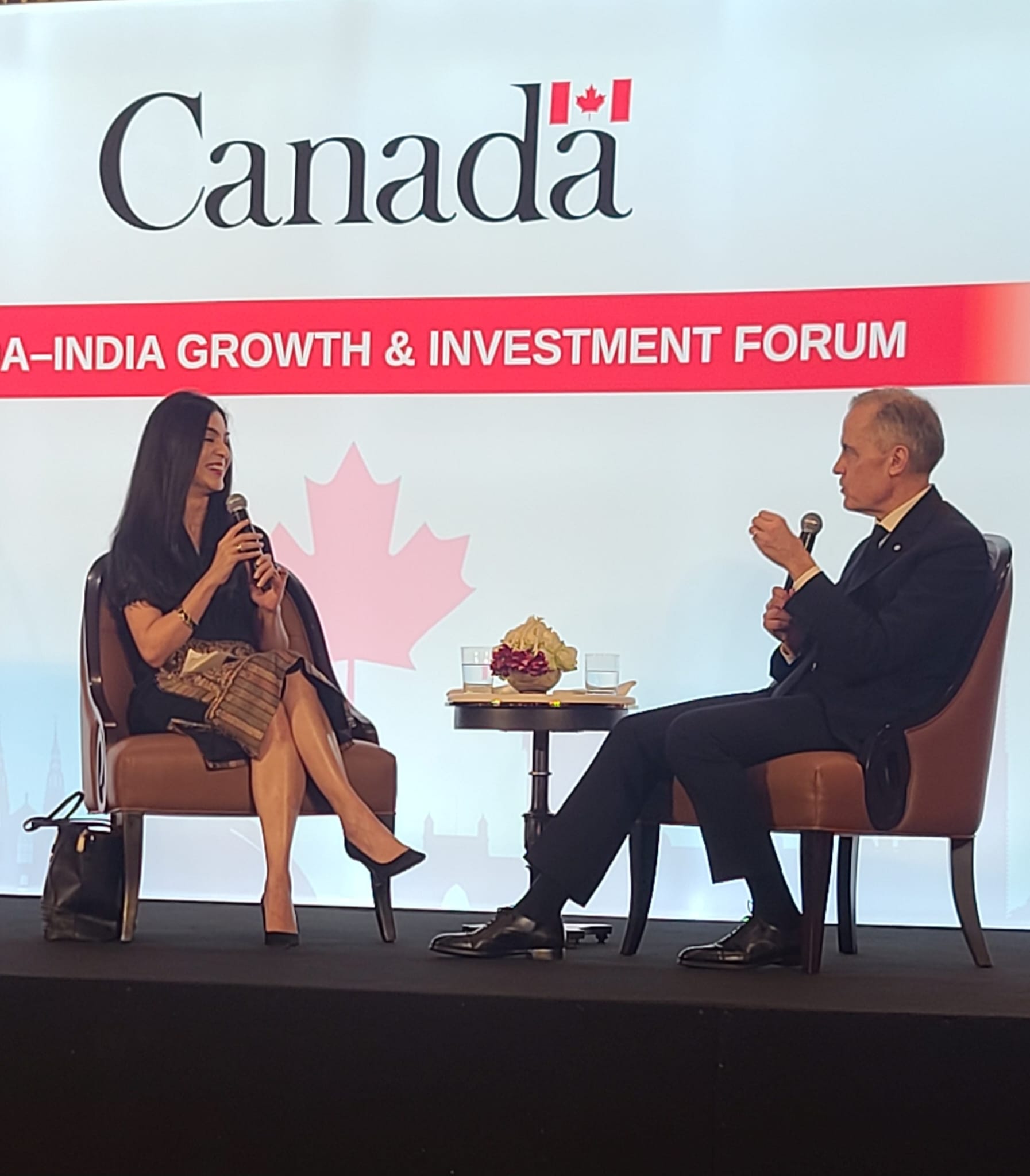
Prime Minister Mark Carney brought his Davos message to India on day two of his visit, delivering a forceful address to business leaders and declaring a reset in Canada-India economic ties.
Speaking at the Canada-India Growth and Investment Forum in Mumbai, Carney blended global strategy with direct commercial ambition. Before roughly 100 business leaders, he framed the current geopolitical moment in blunt terms.
“This is a rupture, not a transition,” Carney told the audience, warning that the “old comfortable assumptions” about security and economic integration no longer hold.
Referencing the analogy that defined his Davos speech, drawn from Václav Havel’s essay about conformity under totalitarian regimes, Carney said the global reaction confirmed that many nations feel the same unease.
“The analogy is there because in a totalitarian regime, everyone is thinking the same thing,” Carney said. “But you don’t necessarily know that everyone’s thinking the same thing. The reaction to that speech was, everyone’s thinking the same thing.”
He added, “The main thing I took from that speech, I hate to say it, the analogy was right.”
Carney named India as one of the countries aligned with that thinking. He positioned both nations as middle powers capable of shaping a new economic balance through principled and pragmatic cooperation.
“Pragmatic in recognizing that progress is often incremental, that interests of nations can diverge, and that not every partner will share all our values. We are actively taking on the world as it is, not passively waiting for a world we wish to be,” he said.
Without singling out specific countries, Carney criticized the use of “economic integration as weapons” and “tariffs as leverage,” a remark widely interpreted as a reference to rising global trade tensions.
He then pivoted to concrete outcomes. Carney said he believes Canada and India can sign a comprehensive trade agreement by the end of the year, adding he hopes to see “the ink dried” before G20 leaders meet in December.
He promoted expanded energy exports, including uranium, and called for deeper partnerships in artificial intelligence and defence. He described Canada and India as “natural partners” that stand to gain from stronger supply chains, research collaboration and talent mobility.
“This visit marks the end of a challenging period, and more importantly, the beginning of a new, more ambitious partnership between two confident and complementary nations,” Carney said to applause.
Later in the day, the Prime Minister met senior executives, including Tata Sons Chairman Natarajan Chandrasekaran, to discuss investment pipelines and sector specific cooperation.
Day two signalled a clear shift. Carney is not only exporting a speech. He is translating it into bilateral strategy.
Parvasi Media Group is travelling with the official media delegation and continues to report from ground zero across radio, print, television and digital platforms.
With inputs from Rajinder Saini, Editor-in-Chief, Parvasi Media Group